

The future of interior design isn’t just beautiful. It’s structured. It’s automated. It’s finally organized.
Interior design has always been about vision. Creating beauty, harmony, and human connection through space. But if you ask most design professionals what consumes their day, the answer isn’t always creativity. It’s coordination. It’s spreadsheet hunting. It’s tracking down approvals, reformatting documents, chasing RFIs, and fixing broken presentation links.
In short, it’s design administration. The invisible layer of work that drags the creative process down and eats into margins. This is exactly where AI is about to make its most profound impact.
While the world marvels at AI’s ability to generate room renders and color palettes, we believe the true revolution lies elsewhere.
The Hidden Burden in Every Interior Design Business
Most people outside the industry think interior designers spend their time picking fabrics and arranging furniture. The reality is far more complex.
For every finished room, there are dozens (or hundreds) of finish items selected, presented, approved, scheduled, and procured. Each of those items needs to be documented, with specs, installation notes, dimensions, location assignments, and revisions tracked along the way.
Now multiply that across a multi-family development. Or a 20-room custom home. Or a boutique hotel.
What you get is a staggering amount of administrative drag, often handled manually, across disconnected tools like Excel, InDesign, Canva, email threads, and Dropbox folders.
This isn’t sustainable, and it’s certainly not scalable. It’s a poor use of the creative brainpower design teams bring to the table.
It’s also the precise layer of the business that AI can transform.
AI won’t replace the designer — it will support them. It will become the administrative co-pilot: capturing, organizing, presenting, and updating the vast quantity of structured data that modern projects demand.
What AI Won’t Replace, and What It Will.
Let’s be clear: AI is not coming for your creative vision.
AI won’t replace the deep emotional intelligence that designers use to interpret client needs or compose spaces with soul.
Yes, AI can absolutely help generate mood boards, assemble look books, and even assist in early-stage conceptualization. But its true power lies in support — not replacement.
It will replace the need to:
- Manually reformat a finish schedule when one item changes
- Copy-paste product specs from a vendor website into a spreadsheet
- Rebuild an entire presentation book because the client swapped out a fixture
- Track email threads for approvals and then double-check the latest version

From Inspiration to Implementation: AI’s Real Superpower
At Design.efficiently, we see AI not as a gimmick, but as a structural upgrade for the design process.
We’re not interested in auto-generating “AI rooms” or style boards. We’re focused on the real bottleneck: the design administration layer that kills momentum, erodes trust with contractors, and burns out talented designers.
Here’s is a small sample of what we are currently developing in Design.efficiently:
1. AI-Item Management
- An AI powered .efficiently Clipp’d Chrome extension so design teams can extract all the key data — name, specs, images, documentation — from a manufacturer’s product page in seconds.
- AI passes and classifies this information into our catalog system using structured fields: Division → Type → Subtype.
- Connected with the manufacturer website, it can remain up-to-date at all times.
No more hunting for PDFs. No more broken links. Just structured, reusable, project-ready data.
2. AI-Powered Catalog Search
- Design.efficiently’s AI-powered catalog search allows design teams to ask for what they need in plain language, just like a conversation.
- You can now type or say: “Find me a chrome faucet with a 6-inch reach, around $500” and get precise, relevant results drawn directly from our structured catalog.
- This chat-based experience is layered with contextual awareness, meaning AI understands not just what you’re asking, but what phase of the project you’re in, what rooms it’s linked to, and which options are still outstanding.
3. AI-Schedule Creation
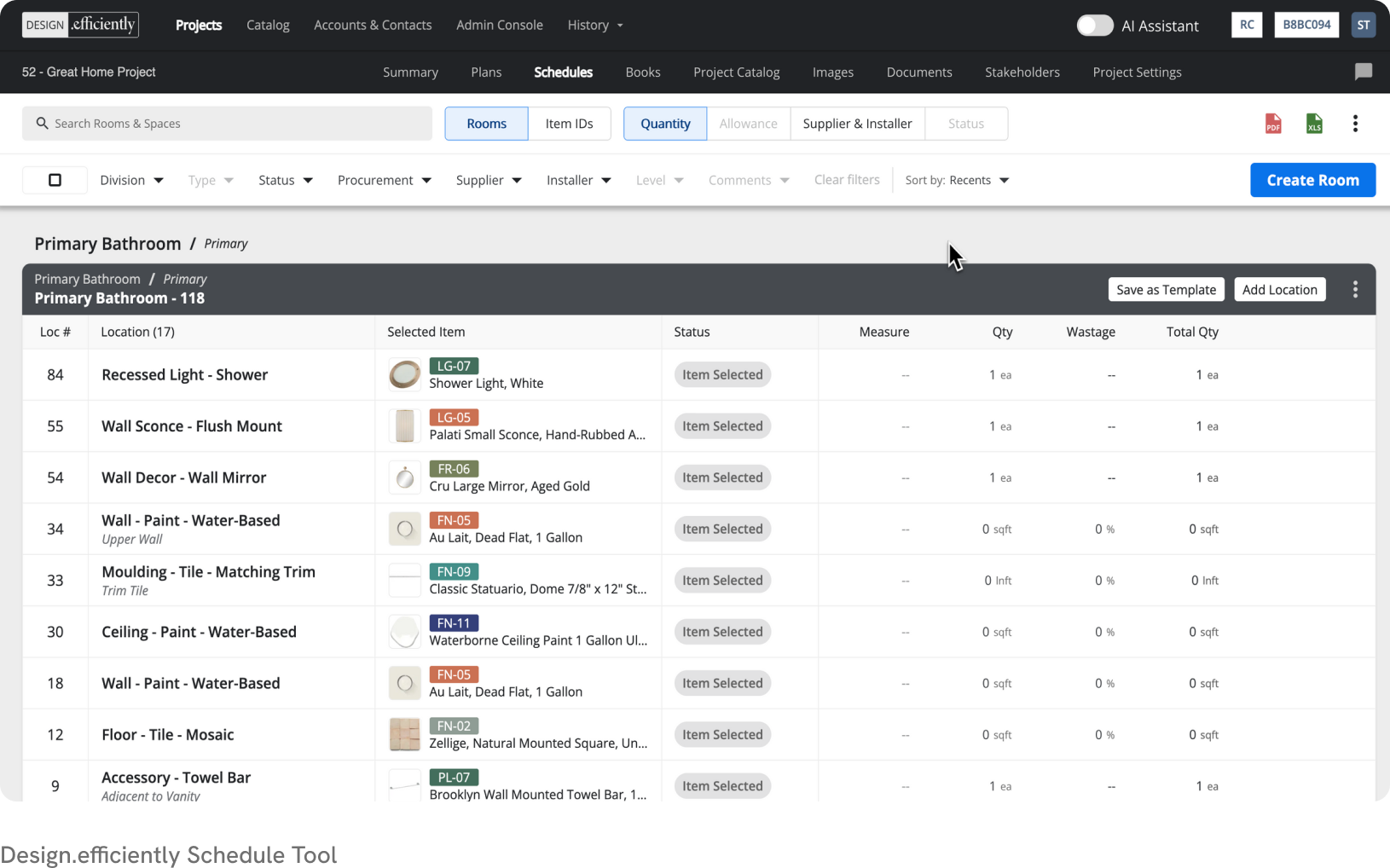
- AI can read construction plans and automatically generate a structured Finish Item Schedule, intelligently populating room and space hierarchies, item locations, and division-based placeholders.
Before generating, it can ask a few clarifying questions like, “Do you want a full schedule, or just plumbing?” to tailor the output to your needs. This pre-built schedule is ready for design teams to simply drag and drop in selections from the catalog. - Instead of starting with a blank canvas, designers are met with a fully structured digital framework that mirrors the project’s scope and plan set.
It’s a massive time-saver that aligns design and construction from day one – reducing missed items, RFIs, and costly rework downstream.
4. AI Schedule Specification Review
- Design.efficiently powered AI can automatically review the Finish Item Schedule and identify gaps, inconsistencies, or missing selections. When required details are absent – like unclear finishes, incomplete dimensions, or missing product specs – the system can generate draft RFIs on the spot.
- These AI-generated RFIs are linked directly to the relevant item locations and can be sent to the architect, builder, or design lead for clarification. This closes the loop quickly and eliminates the guesswork that often causes costly delays.
- This isn’t just helpful. It’s game-changing and it’s just a few of the functions we are currently building in Design.efficiently.
What Happens When Design Admin Disappears?
When the administration layer is handled by structured systems and AI, design teams are finally freed to focus on what they do best.
They stop wasting time on non creative tasks.
They stop arguing with contractors over whether a valve was approved.
They stop losing trust with clients because of disorganized presentations.
They design, and they start scaling because their business now runs on repeatable, intelligent systems.
Building the Intelligent Design Machine
There’s a phrase we use often at Design.efficiently: “More design. Less admin.”
It’s more than a tagline. It’s a call to action.
AI is here. The technology exists. The challenge now is to adopt it in a way that supports the human parts of the process, while eliminating the friction that’s been slowing this industry down for years.
You don’t need AI to decorate. You need it to organize, optimize, and synchronize.
And you need it not just for you, but for the construction teams trying to install your vision, the developers trying to budget your work, and the clients who want clarity without compromise.
AI in interior design isn’t about artificial creativity. It’s about real efficiency. It’s time we design accordingly, Design.efficiently.


